
Support coordination and specialist support coordination
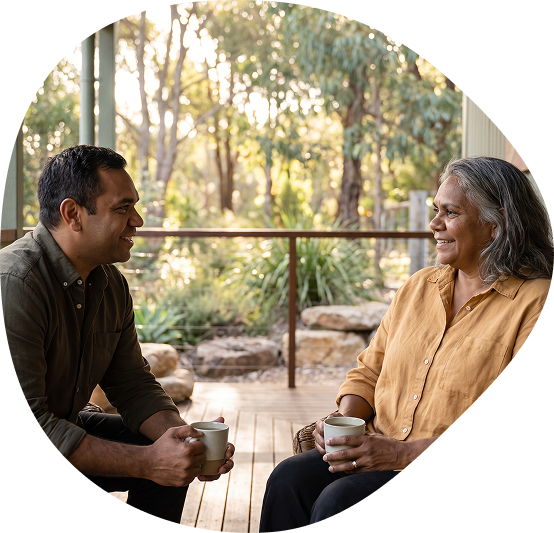
Our First Nations support coordination is led by Aboriginal and Torres Strait Islander coordinators with deep experience in the disability and community sector. They work with the person, their family and their community, with a registered nurse and mental health clinician behind them when health needs are part of the picture.
Our commitment
This is not a mainstream service with a cultural add-on. The people who lead it are Aboriginal and/or Torres Strait Islander, and the way we work starts from culture, family and Country.

Every coordinator in this service holds an identified position. Being an Aboriginal and/or Torres Strait Islander person is a genuine occupational requirement of the role under section 14(d) of the NSW Anti-Discrimination Act 1977.

Each coordinator provides formal Confirmation of Aboriginality: they are of Aboriginal and/or Torres Strait Islander descent, identify as such, and are accepted by their community.

Our coordinators bring many years in disability, mental health and community work, and strong relationships with local Aboriginal organisations, Elders and services.
Why this matters
That gap matters when the person on the other side of the table decides whether someone feels safe enough to come back.
66,348
First Nations NDIS participants at 31 March 2026, 8.6% of all participants.
NDIA Quarterly Report, Q3 2025–26
10%
of NDIS participants in NSW are First Nations people, about 22,800 people.
NDIA Quarterly Report, Q3 2025–26
<1%
of NDIS providers are known First Nations services.
NDIA Quarterly Report, Q4 2024–25
11.4%
of new NDIS participants in the March 2026 quarter were First Nations people.
NDIA Quarterly Report, Q3 2025–26
2.4×
the rate of high or very high psychological distress compared with non-Indigenous Australians.
Aboriginal and Torres Strait Islander Health Performance Framework
~2.5×
the suicide rate of non-Indigenous Australians, for both men and women.
Beyond Blue, citing ABS 2022 data
Our model
We build every plan around the Aboriginal and Torres Strait Islander model of social and emotional wellbeing, which sees a strong self as connected to body, mind and emotions, family and kin, community, culture, Country, and spirituality and ancestors (Gee et al., 2014). Our coordinators lead. Our clinical team backs them up.

Aboriginal coordinator leads
Family and kin, community, culture, Country, and spirituality and ancestors. The coordinator is the main relationship and makes sure the plan reflects who the person is and where they belong.
Shared with our mental health clinician
Mind and emotions. Coordinator and clinician work together, so clinical advice is always shaped by cultural understanding.
Supported by our registered nurse
Body. Physical health checks, medication questions and links with GPs, Aboriginal Medical Services and hospitals.
This brings together the social and cultural model with the medical model. The clinical team is there as backup and never replaces the coordinator’s role or the person’s own choices. Clinical input only happens with the person’s consent.
How we work
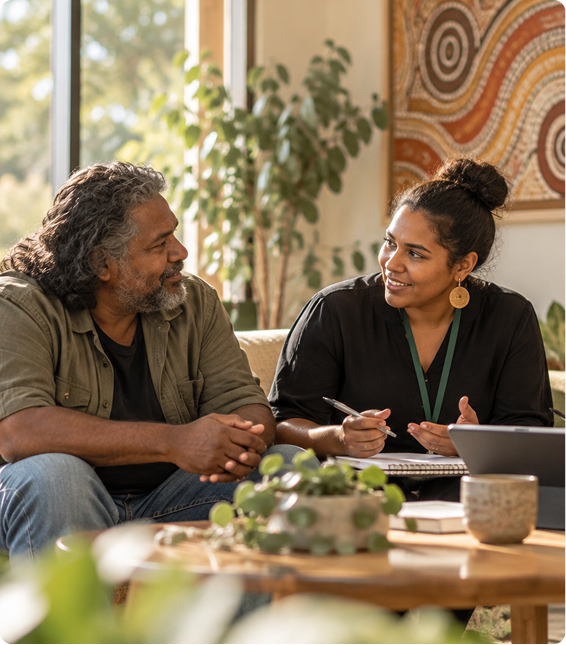
Family and kin are welcome at every step, if that is what the person wants.

Step 1
We start with a yarn, at home, on Country or wherever feels right. No forms until trust is there.

Step 2
The coordinator maps strengths and needs across all seven wellbeing domains. The nurse or clinician adds a health screen where needed.

Step 3
We connect with Aboriginal Medical Services, community organisations, Elders and cultural activities alongside funded supports.

Step 4
We work with the NDIA, housing, health and justice services, and stand beside the person in meetings.

Step 5
We check in against the person’s own goals, and build their confidence to lead their plan themselves.
What we offer

Help to understand and use your NDIS plan, choose providers and connect with community and cultural supports.
For complex situations such as housing crisis, hospital discharge, justice involvement or high health needs, with close clinical backup.

For people living with psychosocial disability, focused on recovery goals, connection and building independence.
Our team

Aboriginal Support Coordinator
Gwen leads our First Nations-led support coordination. Her mob, Country and a short introduction in her own words will be added here with her approval.

Clinical backup
Registered Nurse, Mental Health Clinician and Newpath’s Founder. Prince supports Gwen on physical and mental health, medication and clinical liaison, only with the person’s consent.
No. You have the same choice of provider as every NDIS participant. This service is here if you want a coordinator who shares culture and works this way.
Yes. Tell us what matters to you and we will do our best to match you, and be honest if we can’t.Yes. Tell us what matters to you and we will do our best to match you, and be honest if we can’t.
No. Clinical backup is offered, never forced. They only become involved with your consent, and you can change your mind at any time.
Yes. You decide who is involved, including family, kin, Elders or an advocate.
Anyone, with the person’s agreement: the person themselves, family, an LAC or NDIA planner, a hospital, an Aboriginal Medical Service or another provider.
Common questions
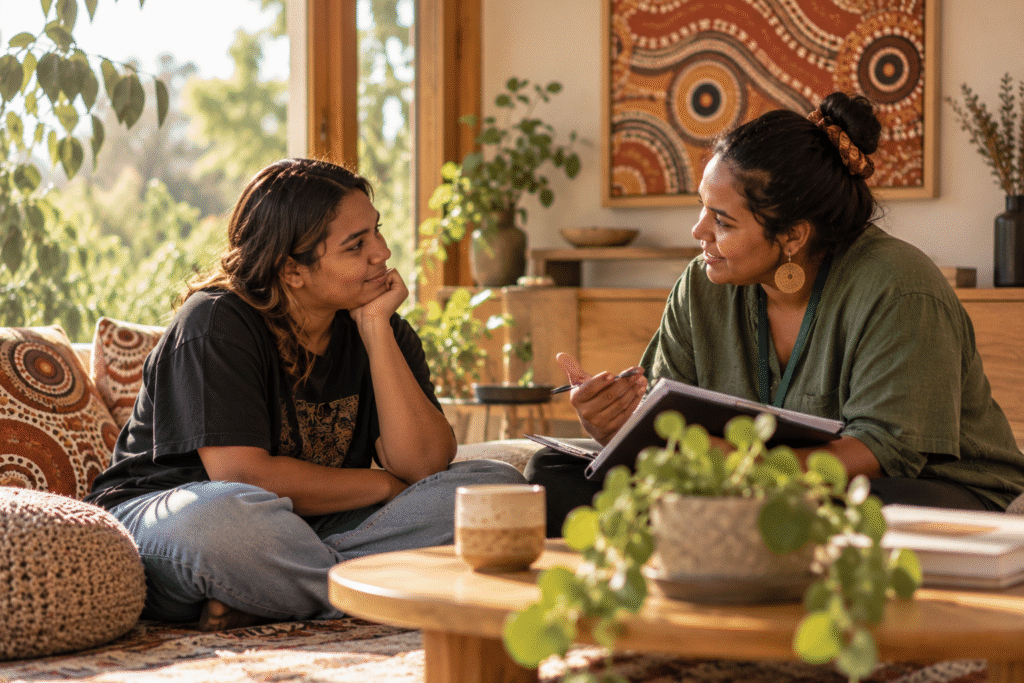
Call or email to have a yarn about referral, availability or whether this service is the right fit.
A statement from our founder
The Dharug people have cared for this Country for tens of thousands of years, and they care for it still. I pay my respects to their Elders, past and present, from the deepest part of my heart.
I am an outsider, and I always will be. This is stolen land, and I have been given the opportunity to live and work on it. I hope that in this life I can give back, in every way I can, what I have received from this land. This service is my way of beginning to do that, for the community whose land I am passing through and using.
Founder and Director, Newpath
Organisation ID:
4050174136
© Copyright Newpath